
Maintenance for rented houses, duplexes and small multiplexes

No superintendent, no boiler room, no management office. We are the one number every tenant in the building calls about repairs.

  • Notice given to every affected unit
  • Heat rule checked against each lease
  • Older materials quoted for what is behind
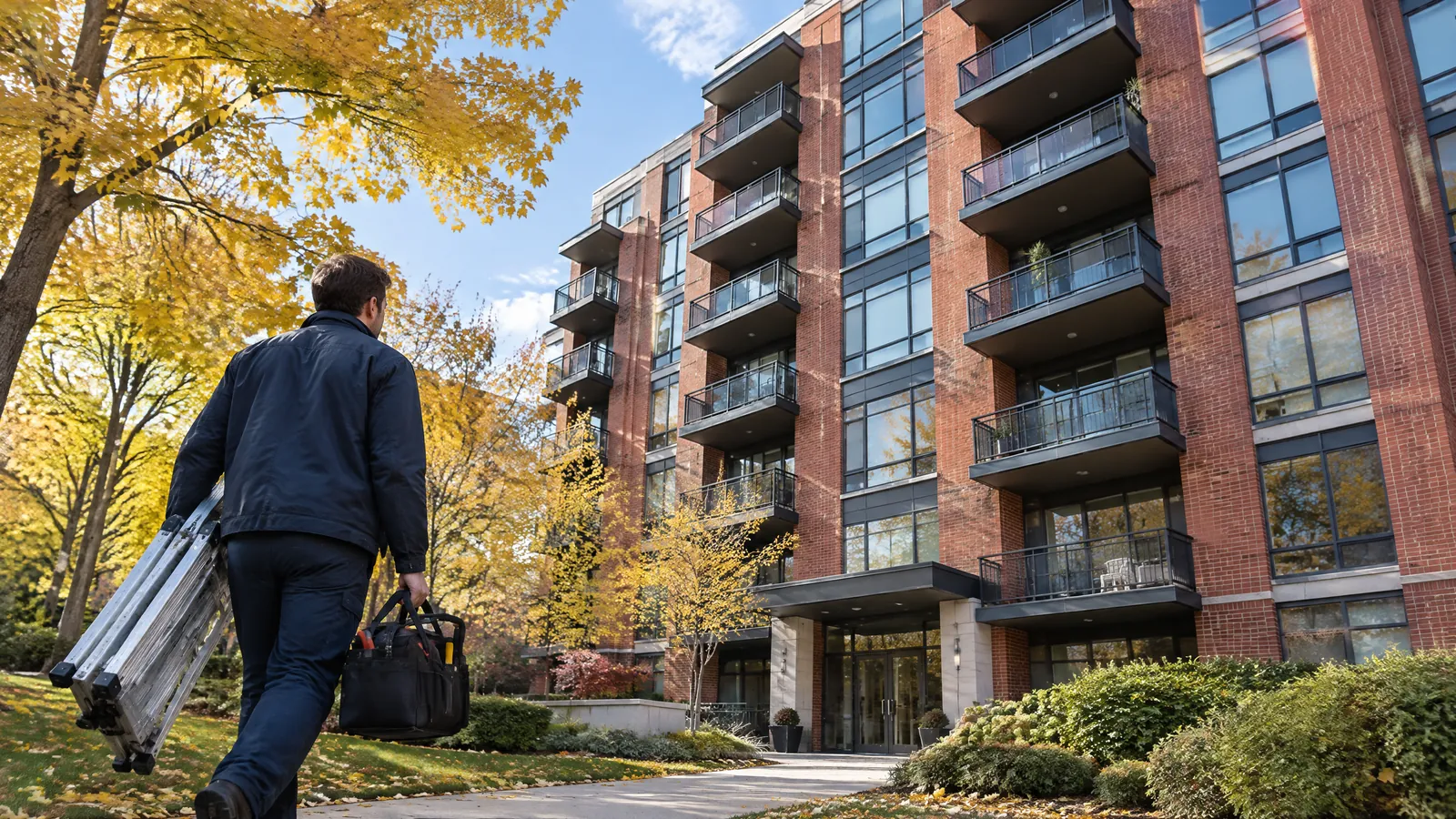
A maintenance technician carries a step ladder and tool bag up the walk of a red brick Toronto apartment building under golden maples
$150
Service call, credited when the work goes ahead
2 hours
Emergency trade on site in the GTA, target
3 business days
Routine repair done, target
1 invoice
Per job, whatever the trades

In a rented house or a small multiplex the owner answers for the whole property, one furnace often serves every unit, and the tenant downstairs is the first to know when the roof water has nowhere to go. Toronto permits four unit multiplexes city wide, and six unit buildings in some parts of the city.

01

Small building, the same duties

RentSafeTO registration starts at three storeys and 10 units, so most houses and multiplexes sit outside it. Chapter 629, Property Standards, does not.

The owner repairs, maintains and keeps the property clean, takes immediate action on any unsafe condition, and keeps every supplied facility working safely (section 629-5). The occupant keeps the unit clean and sanitary, keeps exits clear and co-operates with the landlord on repairs (section 629-6).

02

Roof water is cheaper to clear than to pump out

Chapter 629 requires roof drainage to run to an eavestrough and a downpipe that discharges into the building drain or no more than 150 millimetres above grade, directed so it does not damage the neighbour's property or ice a walkway (section 629-20). Every eavestrough, flashing and downpipe is kept free from leaks and obstructions.

Clearing them each fall costs less than one wet basement unit. See exterior and grounds.

03

One furnace, two or three tenancies

A shared furnace, water heater or panel means one repair touches every unit, and shutting the water off for a valve upstairs shuts it off downstairs too. Each unit we need to enter gets its own written notice, with the reason, the day and a time between 8 a.m. and 8 p.m., under section 27 of the Residential Tenancies Act.

Who pays for heat decides the heat rule. Toronto's minimum of 21 degrees Celsius from October 1 to May 15 applies where heat is provided at the owner's expense, and in a split house the main floor tenant may pay the gas while the basement tenant does not. We check the lease for each unit before treating a cold unit as a no heat call.

04

Older houses hide older materials

  • Knob and tube wiringFound behind a fixture, it stops the fixture swap until a Licensed Electrical Contractor has looked at the circuit.
  • Cast iron and galvanized pipeStacks and supply lines crack or seize when disturbed, so the plumber quotes for what is behind the wall, not only the fixture.
  • Loose fill insulationIn an attic or wall, it is left alone until it has been tested.

We only use ECRA/ESA-Licensed Electrical Contractors.

05

Questions

Does RentSafeTO apply to a Toronto triplex or fourplex?

Not by size alone. RentSafeTO registration applies to rental apartment buildings with three or more storeys and 10 or more units, so a house split into two to four units falls outside it. Chapter 629, Property Standards, still applies.

Who is responsible for the eavestroughs on a rented house in Toronto?

Chapter 629 puts the duty to repair and maintain the property on the owner, and requires every eavestrough, gutter, flashing and downpipe to be kept free from leaks, defects and obstructions and in good repair.

Does Toronto's 21 degree heat rule apply when the tenant pays for heat?

The City applies the 21 degree minimum from October 1 to May 15 where heating is provided at the property owner's expense. Where the tenant pays for the heat, check what the lease says about who supplies it.

How many units can a Toronto house be converted into?

Four unit multiplexes are permitted city wide. Six unit permissions vary by location. A conversion still needs building permits and has to meet zoning and the other City by-laws.

What counts as an emergency?

Plumbing, electrical, major appliance and heating or cooling failures, lockouts, and a door that will not lock. These are answered 24 hours a day, 7 days a week, by phone and text. This website is not an emergency line.

06

Sources

Get started

Send your first house or multiplex job

Give us the address, the repair and how each unit is reached. We confirm the service call before booking and quote the repair from site.

  1. Tell us what you manageThe buildings, the trades you use today and where it hurts.
  2. We reply with a planHow residents reach us, your approval limit and how the record comes back to you.
  3. Start with one jobJudge us on the report and invoice it closes with.

Fields marked required must be completed.

Please leave out tenant details and access codes. Privacy notice. This form is not an emergency line.